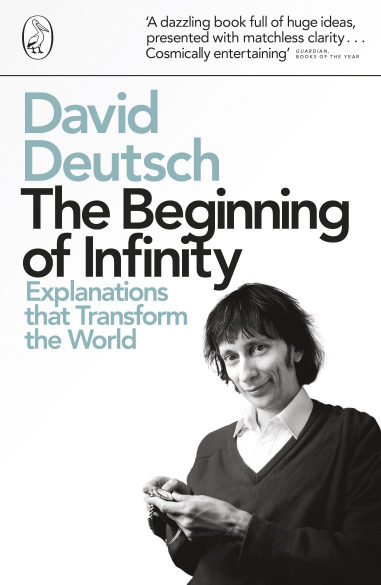
The Beginning of Infinity: Explanations That Transform the World
Penguin · 2011 · English
- 18 chapters + introduction
- 488 pages
- 174,475 words
- ~14h 30m read
David Deutsch argues that the scientific revolution inaugurated an open-ended, potentially unlimited growth of knowledge, driven not by experiment alone but by the human quest for good explanations — theories that are hard to vary without destroying their explanatory power. This single standard, he contends, unifies epistemology, physics, biology, mathematics, politics, and the philosophy of mind into one coherent vision of why progress happens and why it need never stop.
Whole-book summary
Deutsch's central claim is that all sustained human progress — scientific, technological, moral, and political — flows from a single source: the Enlightenment tradition of seeking good explanations, meaning theories whose specific details are essential to what they claim rather than interchangeable ornaments. Against empiricism and inductivism, he argues that knowledge is never passively read from experience but is always a creative conjecture tested against it; against instrumentalism, he insists that our best theories genuinely describe reality rather than merely predicting meter readings. The book's unifying criterion — explanatory hardness-to-vary — is applied everywhere: it distinguishes science from myth, reveals why biological evolution and human knowledge-creation are the only genuine processes that produce new information, exposes why creationism and anthropic reasoning are bad explanations, and explains why a tradition of open criticism is both epistemologically and politically indispensable.
From this foundation Deutsch ranges across quantum mechanics, the multiverse, the mathematics of infinity, artificial intelligence, the philosophy of mind, and the history of symbolic universality. He defends the many-worlds interpretation of quantum theory as the only honest account of what the formalism says, argues that computation and mathematics are ultimately grounded in physics rather than the reverse, and traces a recurring pattern — the jump to universality — by which narrow tools (alphabets, numerals, computers, genetic codes) unexpectedly become capable of representing everything in their domain. The Socratic dialogue chapters dramatize how fallibilism applies to moral and political knowledge just as much as to scientific knowledge, and the chapters on optimism ground a rational, non-naive case for expecting problems to be soluble: not because the future is guaranteed, but because every problem has a solution if we know enough, and the only alternative to creating new knowledge is helplessness.
The book matters because it offers a genuinely unified philosophy of knowledge at a moment when specialization makes such syntheses rare. Deutsch's arguments cut against both the scientistic reductionism that dismisses high-level explanations as mere shorthand and the postmodern relativism that denies objective differences between better and worse ideas. His answer to whether progress must eventually end — resoundingly no — is not optimism as a temperament but as a logical consequence of fallibilism: since we cannot predict what our successors will know, we cannot identify any fixed horizon, and the universe's laws are everywhere available as raw material for knowledge-creation. The beginning of infinity, for Deutsch, is not a historical moment already past but a threshold any civilization crosses the moment it commits to open-ended explanation.
Key ideas
Good Explanations Are Hard to Vary
The book's master criterion: a theory is a good explanation when its specific details are load-bearing — remove or alter them and the explanation collapses. This distinguishes science from myth, which can absorb any new data by adjusting its stories. Testability matters, but it is secondary; most false theories can be dismissed before any experiment because they fail this harder test first. The criterion unifies epistemology, physics, biology, and politics under a single standard for evaluating knowledge.
Knowledge Is Always Creative Conjecture
Deutsch argues against empiricism's core claim that knowledge is read off experience. Observation can test a theory but cannot generate one, because recognizing any "repeated" experience already requires background theory to decide what counts as the same. Scientific theories routinely describe stellar interiors, sub-atomic events, and cosmic history — none of which anyone has directly sensed. Knowledge advances through bold creative guesses, not through the patient accumulation of data, and errors are corrected by criticizing theories, not by purifying observations.
Explanatory Reach Emerges Automatically
A good explanation's reach — its applicability beyond the cases that inspired it — is not something its creator adds. It is locked into the explanation's content and emerges automatically once the explanation exists. This is why Newton's mechanics could describe planetary motion no one had yet observed, and why good political or moral arguments apply to situations their authors never imagined. Reach is the diagnostic sign that an explanation has captured something real rather than merely fitting a finite data set.
The Jump to Universality
Narrow, specialized systems — alphabets, numerals, weaving looms, computers, genetic codes — have repeatedly crossed a threshold at which they become capable of representing or computing everything in their domain, not just the specific cases they were built for. Before the jump, you craft a dedicated artifact for each problem; after it, you program a universal artifact once and let it handle any problem of that type. The historical puzzle is that universality has been achieved repeatedly by accident, then ignored, because pre-Enlightenment cultures lacked the concept that open-ended, abstract progress was possible or desirable.
Fallibilism Replaces Justificationism
No belief can be certified as certainly true by any authority — neither the senses, nor logic, nor tradition, nor consensus. What can be done is to hold beliefs conjecturally and subject them to relentless criticism, replacing those that fail. This fallibilism is not skepticism: some theories are vastly better than others, and progress is real. The practical consequence is that institutions — scientific, political, and cultural — should be judged not by the quality of the knowledge they enshrine but by how efficiently they allow errors to be detected and corrected.
People Are Cosmically Significant
The Principle of Mediocrity — the modern corrective to anthropocentrism — overcorrects. Humans are not cosmically typical: they are complex, chemistry-performing, warm, liquid-bearing entities in a universe that is almost entirely cold vacuum. More importantly, explanatory knowledge transforms any environment it reaches from passive to explosively creative. The same raw atoms produce radically different futures depending on whether knowledge-bearing beings are present, making intelligent life the most significant phenomenon known, not a marginal accident.
Optimism as Epistemology, Not Temperament
Deutsch defines optimism as the claim that all evils stem from insufficient knowledge, making every problem in principle soluble. This is not a prediction of success but an explanation of failure: every setback reflects a correctable gap in understanding. Because the future is shaped by knowledge not yet created, its outcomes are genuinely inconceivable — neither Russian-roulette probability nor prophetic doom applies. The precautionary principle is as epistemically reckless as blind risk-taking, because it assumes existing knowledge is safe while ignoring that ignorance has destroyed virtually every civilization in history.
The Many-Worlds Interpretation Is the Honest Account
Deutsch argues that the many-worlds interpretation of quantum mechanics is not a philosophical extravagance but the only coherent account of what the quantum formalism actually says. Quantum interference — the rejoining of differentiated histories — is direct experimental evidence that those histories are physically real. Refusing to interpret quantum theory, as the Copenhagen interpretation demands, is a philosophical choice to place explanations beyond scrutiny, not a scientific necessity. Decoherence explains why we never experience superpositions without requiring any special collapse of the wave function.
Abstractions Are Genuinely Real
An entity is real if it appears in our best explanation — including abstract entities like prime numbers, programs, social institutions, and the second law of thermodynamics. Reductionism's insistence that only the lowest physical level is real is a philosophical prejudice, not a scientific finding. Many of our most reliable bodies of knowledge — thermodynamics, historical causation, mathematics — resist reduction, yet are not mere shorthand. Scientific progress is possible because theories can be wrong and still point toward truth, letting ideas die so people do not have to.
Democracy as Error-Correction, Not Preference Aggregation
Arrow's Impossibility Theorem and the centuries-old apportionment paradoxes prove that no procedure for aggregating preferences into collective decisions can be simultaneously fair, rational, and paradox-free. But these results indict social-choice theory, not democracy. The right criterion for evaluating political institutions — Popper's criterion — is not how accurately they mirror existing opinions but how easily they allow bad policies and rulers to be removed without violence. Plurality voting is theoretically superior on this standard: it makes governments sensitive to small opinion shifts, forces genuine persuasion of majorities, and cleanly assigns blame when policies fail.
Memes, Static Societies, and the Suppression of Creativity
Cultural evolution operates through memes — self-replicating ideas that spread by causing the behaviors needed to copy them — subject to the same underlying logic as biological evolution but through radically different mechanisms. Static societies persist not primarily through censorship but by raising children whose capacity for independent thought is disabled before threatening ideas can form. Rational memes survive precisely because they welcome criticism: only genuinely true or deep ideas hold up when selection criteria vary unpredictably across people and generations. Dynamic societies are exceptional and historically fragile.
Beauty Has Objective Dimensions
Flowers are beautiful to humans not by accident but because competitive pollination across a species gap required encoding genuinely objective, hard-to-forge attractiveness signals. Humans share the same universal recognizer. Beauty and scientific elegance share a structural property — being hard to vary while still working — which suggests aesthetic standards are not purely arbitrary but track something real. Because each human mind is informationally unique on the scale of an entire species, artists face the same cross-gap signaling problem as flowers and insects, making the reach toward objective beauty both possible and necessary for real communication.
The Infinity of Ignorance Is the Precondition for Progress
Treating current theories as likely misconceptions rather than near-final truths is not pessimism but its opposite. Every successful explanation opens new, deeper problems. Dark energy, quantum gravity, and the measure problem in infinite cosmologies reveal that today's ignorance is more fundamental, not less, than a century ago — making end-of-science arguments empirically untenable. The prophetic fallacy that knowledge is nearly complete is not merely an intellectual error; it is a moral and political danger, because utopians and authoritarians both depend on the claim that all important questions are already settled.
Real AI Requires a Jump to Universality, Not Better Imitation
Decades of chatbot development have produced no genuine thinking because the entire approach confuses imitation of intelligence with intelligence itself. The Turing test is behaviorist: judging outputs without understanding the generative mechanism can confirm only successful mimicry, never genuine creativity. All knowledge in a chatbot is pre-loaded by its programmer, so no matter how rich its repertoire, it creates nothing new. Real artificial general intelligence will not be a gradual improvement on this approach but a discontinuous jump to universality — producing a full person with creativity, consciousness, and meaning.
Reading notes
Use hard-to-vary as a first filter
Before testing or debating any claim — in science, policy, or personal reasoning — ask whether it is hard to vary. If its central assertion could be freely adjusted to accommodate any counterexample without changing the rest of the argument, it is already a bad explanation and can be set aside without waiting for experimental refutation. This applies equally to theories in physics, historical narratives, and self-justifying beliefs.
Judge institutions by error-removal, not correctness
When evaluating any institution — a scientific community, a democratic government, an organization — Deutsch's book directs attention away from whether it currently holds the right views and toward whether it can efficiently identify and remove wrong ones. Ask: what happens when someone inside this institution is badly mistaken? If the answer involves suppression, conformity pressure, or structural inability to course-correct, the institution is fragile regardless of how good its current outputs look.
Take the multiverse seriously as a literal claim
Deutsch intends the many-worlds interpretation as a description of physical reality, not a metaphor or philosophical option. Readers who encounter quantum mechanics elsewhere will find this book useful for distinguishing the empirically supported quantum multiverse from the purely speculative parallel universes invoked in anthropic fine-tuning arguments — a conflation the book explicitly warns against. The criterion is always the same: which account is harder to vary?
Trace your cultural inheritances for anti-rational memes
The book argues that anti-rational memes persist inside dynamic societies disguised behind modern self-images of rational autonomy. A practical reading note: when you find yourself enacting a narrowly defined behavior that persists even after its stated justification disappears — and you can produce only bad explanations for it — treat that as a signal worth examining. The behavior may be carrying a meme that survives not because it is true or beneficial but because it is effective at spreading.
Resist the allure of completeness
The closing argument of the book is that the belief you are nearly done — in any field of inquiry, any personal project, any political program — is the specific form of pessimism most likely to produce dogmatism. A useful reading practice: wherever the book argues that a previous generation believed knowledge was nearly complete (Victorian physics, Athenian philosophy, Enlightenment political theory), notice the structural similarity to any domain where you currently feel confident, and hold that confidence more lightly.
Tensions and qualifications
Fallibilism does not mean all views are equally good
Deutsch is careful to distinguish fallibilism from relativism. Acknowledging that any belief may be wrong does not imply that no belief is better supported than another. Some explanations are vastly harder to vary, have greater reach, and have survived more criticism — and these differences are objective. The book's argument against relativism is internal to fallibilism, not a retreat from it.
The multiverse is the least assumption, not the most
Readers often treat the many-worlds interpretation as ontologically extravagant. Deutsch argues the reverse: positing additional universes is what the quantum formalism requires, while collapsing it to a single history requires adding unexplained machinery. The charge of excess should fall on Copenhagen, not on many-worlds. This is a minority position among physicists and deserves engagement with the counterarguments, which the book does not fully provide.
Optimism is rational only alongside the tradition of criticism
Deutsch's case for open-ended progress depends entirely on civilizations maintaining the Enlightenment tradition of open criticism. The historical record shows this tradition is fragile, exceptional, and repeatedly extinguished. The book's optimism is therefore conditional: the beginning of infinity remains only a beginning if societies actively preserve the institutions — tolerance of dissent, protection of critical inquiry — that make progress possible. Optimism without that condition is exactly the blind variety the book rejects.
The jump to universality may be harder than the examples suggest
The book's most compelling examples of the jump to universality — alphabets, Arabic numerals, the Turing machine — are historical successes. It does not dwell on the many near-misses or the domains where universality has not been achieved. Readers should be cautious about using the pattern to predict where the next jump will occur, which is precisely the kind of future knowledge the book argues cannot be predicted.
Meme theory describes transmission, not all of culture
Deutsch uses meme replication to explain why static societies persist and how dynamic ones differ. But the framework is more illuminating for explaining cultural lock-in than for explaining specific cultural content. The book does not claim memetics explains what makes any particular idea true or beautiful — only why some ideas spread and others do not. These are different questions, and conflating them would misread the argument.